

Interview Marcia Kadanoff
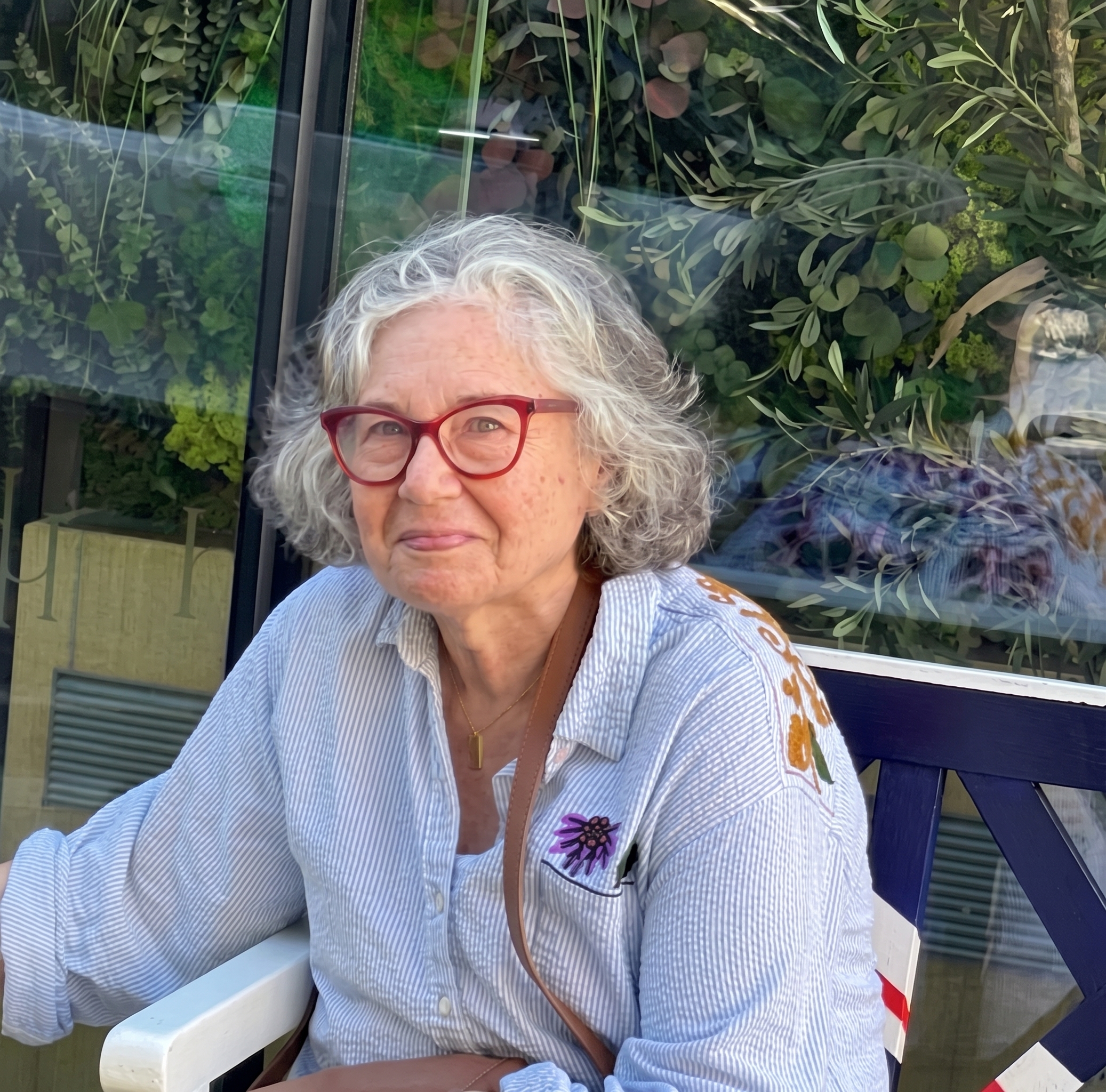
ABOUT YOU
Who are you?
I am a kick-ass professional woman who has retired. I spent most of my career in technology marketing—first to businesses, then to consumers, early adopters, and prosumers (professional consumers buying for themselves).
I was an early adopter of mobile technology, one of the first people to carry email on a PDA, the predecessor to smartphones. I ran my agency off email while roaming.
I also collect modern art and photography; that keeps me motivated.
I have an MBA from Stanford (where I met my husband) and a BA from Harvard in Psychology and Social Relations. I’m married with one daughter, now 35 and married herself. I live in Portugal and am pursuing permanent residency—we expect to stay.
I’m the daughter of eminent physicist Professor Leo Kadanoff and librarian Diane Gordon Kadanoff. My mother was one of the first feminists. As the daughter of an academic, I traveled almost every summer; living in Europe was always on my bucket list.
From BA in Psychology and Social Relations how have you become one of the early marketers at Apple?
In the early 1980s, fresh out of college, I wanted to save the world—typical of a child of the ’60s and ’70s. My father was visiting me in Boston when I attended a Homebrew Computer Club-style meetup. Steve Jobs and Steve Wozniak were there talking about the Apple I and Apple II. I was entranced. I decided I wanted to go to California and help make personal computers ubiquitous.
I applied to Stanford Business School and when they called to admit me I felt honored, excited, and scared. The year I graduated (1985) Silicon Valley was in a slump and wasn’t hiring non-technical people.
I started at The Clorox Company in Oakland. I hated it, but the two years there gave me rigorous packaged-goods marketing discipline: branding, consistency, promotion schedules, research. I later called it my second MBA.
Apple recruited me precisely because of that packaged-goods background. At the time Apple had about 4,500 employees and was the dominant branded computer company selling to consumers. My first job was introducing the Mac II and the Mac SE (the first Mac that actually worked without constant floppy swapping). At the time Apple sold through stores that it did not own so we had to convince the channel so they in turn would convince consumers.
There, I learned the power of radical message simplification and visual consistency. We gave every computer a fixed silhouette so people could instantly recognize the SE or the Mac II. John Sculley (ex-Pepsi) was running the company; we spoke the same packaged-goods language.
Microsoft later came calling—they only sold to businesses and wanted to learn how to sell directly to consumers. I briefed peers there on how to advertise Excel and Word,information readily available simply by analyzing our media buys. From this, I developed a lasting hypothesis about partnerships: each side values what they will give the other differently. Microsoft put a high value on the information we provided and consequently launched Excel and Word on the Mac first, before they launched the same apps on Windows. We - at Apple - wanted to have an “exclusive” on these apps but did not value the information we gave away very highly. My key learning from this was that a win-win deal doesn’t have to be reciprocal in actual value … only in perceived value.
Looking back at your career, what single principle has guided how you choose (and leave) rooms?
After Apple I managed a brand in decline at Sun Microsystems, then became a 49 % ownership in what started out as an events company. I helped the company reposition into direct mail and relationship marketing, drove the company to $20 million in revenue with no venture capital, and taught Silicon Valley how to use direct response. This particular business relationship ended badly, I’m sad to say..
I moved into tech-startup marketing as interim or full VP/CMO. I also spent time on the agency side because I loved working with creatives and understood that even the most rational B2B decision has a huge emotional component—creative unlocks it.
I always kept the ability to walk away, especially in situations where I was asked not to present my authentic self. Too many tech companies are toxic especially to strong women leaders. Since the late 1990s, I’ve been telling other women leaders they needed “f^ck-you money” in the bank so they could leave toxic rooms. The day you take VC money it ceases to be your company.
Later I hit a ceiling that was never framed as sexism. The point made was “marketing is a young person’s game.” My last formal, full-time CMO role was around 2010.
After that I pivoted toward civic and maker work. Tech was arriving; leaders wanted to contribute positively but didn’t know how. I joined City Innovate that brought regular residents, tech people, the emerging billionaire class, and civic leaders together. I ended up working with this company in its various forms for 10 years before retiring in 2023.
You said you are ‘retired.’ What does a purposeful retirement actually look like for you now?
I “retired” at least five times; it never fully stuck until 2023 when my health intervened. What has guided me throughout is the freedom to choose — and leave — rooms on my own terms, the practice of reciprocity in partnerships, and the knowledge that mentoring people is the part of the work that lasts.
One of the things I am most proud of is the roughly 200 people whose careers I positively affected through mentoring. Mentoring is an under-appreciated skill.
ABOUT YOUR MISSION
Today as a mentor and board advisor what role do you see an external ‘truth-to-power’ advisor play, and how does that same idea apply to a personal board of advisors?
I learned that every company has a moment of maximum sale value; too many miss it because founders and boards fall in love with their own success. An external advisor who will speak truth to power is invaluable. The same principle applies to a personal board. Find the five to seven people you trust for major life and career decisions and consult them each and every time you anticipate a pivot. This is what I do.
You co-created the Maker City Project with the belief that arts and makers are real economic engines. How has that idea been proven?
In San Francisco I joined City Innovate convenings that brought residents, tech leaders, and civic leaders together. With my fellow Apple colleague Peter Hirschberg I co-founded the Maker City Project. The core idea is that a flourishing community needs a strong base in the arts - broadly defined by makers and people who work with their hands. The United States used to be a nation of makers. We wanted to help cities identify three authentic strengths, market those strengths, and convert maker culture into economic vitality and livelier neighborhoods. The Kauffman Foundation funded a practical playbook for mayors; we wrote the Maker City book around it.
A decade later the hypothesis has been validated. Cities that bounced back fastest from Covid’s emptying downtowns were those with active arts and maker communities. Pop-up stores and neighborhood-level energy are now common. Arts and makers have a real impact on cities: they drive tourism, commerce, and liveliness in a way pure tech companies cannot.
Based on your research and experience with the Maker City Project, what does preparing a region for the future look like?
We need to stop concentrating all innovation and wealth on a handful of coasts or capitals. Spreading the goods is essential for climate resilience and reducing inequality. Climate change and income inequality are not an either/or. Universal basic income experiments - especially those giving artists or low-income people a modest monthly allowance - have been strikingly successful. The survival anxiety drops enough that people can create and explore.
As AI displaces workers we will need meaningful activity; making things with one’s hands is one of the best sources of meaning. Preparing a region for the future means identifying three authentic strengths, feeding neighborhood energy rather than only the city center, bringing art to people, and rebuilding neighbor-to-neighbor connection so communities can better face crises together.
ABOUT REDBRIDGE
You established yourself in Portugal. What does Portugal uniquely offer as a base for your next chapter - both personal and professional?
Covid lockdowns and the political shifts inherent in the 2016 and 2024 elections crystallized the decision to leave. Colleagues in the crypto community had already pointed us to Portugal: “If you loved Barcelona before it became Disneyland, you’ll love Lisbon.” We started Golden Visa paperwork. When the 2024 election results came in, what was planned as a temporary “senior year abroad” became permanent.
Portugal’s generosity of spirit, quality of life, and relative political calm felt like a safe harbor - and we also simply love the country.
Portugal has been smart with successive Golden Visa iterations that push investment inland and into funds rather than pure Lisbon real estate. The same logic should guide where we cluster innovation.
American investors still ask “Why Portugal?” How should Portuguese founders position themselves? And how should they reinforce the bridge between the US and Portugal?
Portuguese founders need crisp answers. India had English-speaking customer-service talent at lower cost; Ireland had time-zone and tax advantages. Possible Portuguese clusters: PropTech (old buildings that need renovation, missing walkability data, fragmented listings), applied AI for business-process improvement, government technology (Estonia has been successful), and perhaps fashion, textiles, or shoes.
VCs rarely invest early outside their own backyard; they want hands-on control. Family offices are a more promising bridge - many already have second homes or curiosity about Europe. The rule of three still applies: pick a few dense innovation clusters, train cohorts of entrepreneurs to world-class standards, and send them with a clear narrative.
What advice would you give Portuguese entrepreneurs considering a move or expansion into the United States right now, and what should American founders or family offices understand about Portugal before they invest?
Moving entire Portuguese teams to the United States is expensive and, under current conditions, visas are hard to get especially for non-white-presenting talent. Later-stage plays that truly address the U.S. market may make sense; early-stage ones usually do not. Africa, where Portugal still has living commercial ties, is another potential bridge worth exploring carefully.
I keep returning to reciprocity in partnerships, the necessity of f^ck-you money, the economic and human value of makers and the arts, and the urgency of spreading opportunity beyond a few coastal clusters. Portugal feels like a place where those ideas can still take root.
Follow Marcia Kadanoff via LinkedIn
Interview by Aurélie A. Vincent, Founder of Embody Agency
